
The Number That Broke the Odometer
On August 19, 2026, the U.S. Treasury confirmed what market watchers had been counting down for weeks: the federal government's gross national debt crossed $40 trillion for the first time in history, landing at $40.047 trillion. To put the pace in perspective: it took the United States 192 years to accumulate its first trillion dollars of debt. It took just five months to add the most recent one. The debt hit $30 trillion in January 2022 and has grown by another $10 trillion in under five years.
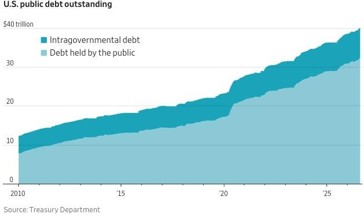
Headlines like this tend to trigger one of two reactions: panic, or a shrug because "the government has always been in debt." Neither helps your financial plan. What matters is translating a macro headline into decisions you can actually act on — which is the purpose of this educational overview.
Why This Time Feels Different
Debt milestones aren't new — we crossed $20 trillion in 2017 and $30 trillion in 2022 without a market meltdown. What's changed is how the bond market is pricing the risk. In the same week debt crossed $40 trillion, the 30-year Treasury yield touched its highest level in nearly two decades, and 10-year and 30-year note auctions drew the weakest demand investors have seen in years. As of August 21, 2026, at 4:00 p.m. ET, the 10-year Treasury yield sits at 4.74% and the 30-year at 5.27%— levels that reflect investors demanding real compensation to keep lending Washington money, not just short-term jitters.
That matters because Treasury yields are the reference rate for nearly every other form of credit in the economy. When the government has to pay more to borrow, so does everyone else. The Treasury Department has already conducted scheduled liquidity-support buybacks in longer-dated Treasury sectors; these operations are intended to support market liquidity and do not guarantee lower yields, but analysts note the intervention is small relative to the size of the Treasury market and unlikely to reverse the underlying trend.
Interest on the debt is now the government's third-largest budget line, ahead of the entire defense budget, with net interest payments on pace to exceed $1 trillion for fiscal year 2026. Every dollar spent servicing debt is a dollar not available for other priorities — and it's a growing claim on future tax revenue and economic output. Gross federal debt equaled approximately 123.3% of GDP on August 19, 2026; CBO projects debt held by the public at 101% of GDP in 2026 and 120% in 2036 (Congressional Budget Office).
Where This Shows Up in Your Life, Not Just the Headlines
This is the part that matters most for investors — building a career, buying a first or second home, raising a family, and just beginning to compound serious long-term savings.
Borrowing costs. The 30-year fixed mortgage rate is currently 6.65% according to Freddie Mac, and other trackers put it closer to 6.8%. Mortgage rates track the 10-year Treasury yield closely, so as long as Washington needs to pay more to borrow, the cost of your next home purchase, refinance, auto loan, or business loan may remain elevated, but rates can move materially in either direction to the ultra-low rates many millennials remember from the 2010s.
Inflation risk to long-duration goals. If markets ever conclude that heavy borrowing will eventually be resolved through looser monetary policy or currency debasement rather than fiscal discipline, that shows up as sustained inflation pressure — which quietly erodes the purchasing power of cash and long-dated bonds sitting in a 401(k) or brokerage account over a 20- or 30-year investing horizon. Core inflation is running at 2.5% as of August 21, 2026 — contained, not alarming — but the fiscal backdrop is a reason to consider discussing inflation sensitivity with a qualified professional in light of objectives, time horizon, liquidity needs, and risk tolerance, not an afterthought.
Bond portfolio construction. Bank of America's chief equity strategist Michael Hartnett has been running an "Anything But Bonds" framework, presenting one strategist's forecast that debt could reach $50 trillion by 2029; this is not a consensus estimate and may not occur, and arguing five-year Treasury yields would need to fall well below current levels before long-duration government bonds look attractive. You don't need to adopt that view wholesale, but it's a signal worth understanding: rising supply of Treasury debt without matching investor demand tends to push yields higher and long-bond prices lower — a headwind for anyone holding long-duration bond funds as a "safe" allocation.
What Markets Are Actually Telling Us Right Now
It's worth noting what hasn't happened. Equities haven't panicked. That's not complacency so much as a market that has priced in a "muddle-through" fiscal outlook rather than a crisis scenario, at least for now.
The labor market, for its part, remains reasonably sound at 4.1% unemployment, and the Fed Funds effective rate sits at 3.63% — giving the Federal Reserve some room to maneuver if growth (currently running at just 1.5% compared with the previous quarter) slows further. That combination — a resilient but decelerating economy, a Fed with some flexibility, and a bond market demanding extra yield for fiscal uncertainty — is the actual environment investors face.
What This Means for Your Plan
A $40 trillion debt figure is not, by itself, a reason to abandon a well-built financial plan or make an emotional portfolio decision. It is, however, a legitimate reason to revisit a few specific things with your advisor:
- Duration risk in your bond allocation. If you're holding long-dated Treasury or bond funds as a "set it and forget it" ballast, this is a good moment to check whether that duration exposure still matches your risk tolerance given a more volatile longer-maturity segment of the bond market.
- Real assets and inflation hedges. Some investors evaluate real assets, Treasury Inflation-Protected Securities (TIPS), or other exposures for diversification, but each carries distinct risks, and diversification does not assure a profit or protect against loss when fiscal and inflation uncertainty is elevated. This is especially relevant if you're already thinking about property as part of a long-term wealth strategy. Treasury Inflation-Protected Securities, bond funds, and real estate can also lose value, and diversification does not guarantee results.
- Borrowing decisions. If a major purchase a home, an investment property, or a business loan is on your five-year horizon, borrowers may compare fixed and variable terms, costs, refinancing risk, liquidity needs, and affordability with a qualified lending professional rather than waiting for a return to 2021-era borrowing costs that may not come back soon.
- Staying invested, not staying still. Equity markets have absorbed this news calmly so far. The current data does not by itself establish a single appropriate investment response; portfolio decisions depend on individual circumstances rather than making a binary "get out" decision based on a single, if historic, number.
The $40 trillion milestone is a symptom of a structural fiscal trend that has been building for over a decade, across multiple administrations and Congresses. It's unlikely to be resolved quickly, and it's not something any individual investor controls. What you can control is making sure your own balance sheet, your savings rate, your debt structure, and your asset allocation are built to withstand a world of structurally higher borrowing costs and persistent fiscal uncertainty. That's a conversation worth having now, while markets are calm, rather than during the next headline that isn't.
"$40 Trillion and Counting." FMeX. 2026.
Sources: AP News; CNBC, Yahoo Finance/The Fiscal Times, BBC News, The Boston Globe; NPR, Investing.com, Al Jazeera; Axios, Freddie Mac; Mortgage Bankers Association, Perplexity Finance data, Perplexity Finance data, The Washington Times.
